Do Not Be Afraid and Keep Your Promises: A Review of Eva Gata’s Posthumous Book «Strange Stories»
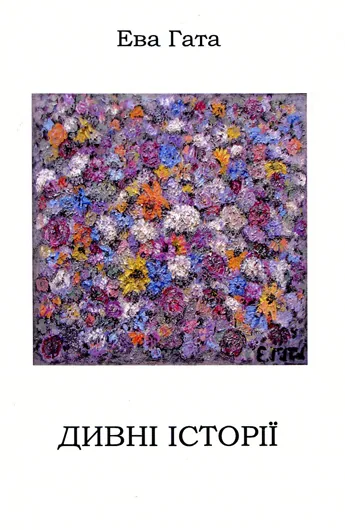
In the foreword to Eva Gata’s posthumous book “Strange Stories” (Lviv: BaK, 2019), we read: “A book-photograph.” Let that stand, for are not almost all books just that? Let us speak only of its inner, X-ray image, so to speak.
Strange stories come to mind in fragments. It is a phenomenon familiar to every writer. A writer’s notebook is the tool used to capture them.
Actually, these notes are usually made public after the author's departure. They then become excellent material for analysing her work.
Eva Gata’s last book is kaleidoscopic by definition. It contains everything she had not managed to shape into prose that she considered worthy of publication. Yet the first, nearly finished story surpasses in quality a substantial body of hastily published contemporary Ukrainian short fiction. Ukrainian literature still says little about an entirely new social stratum: moderately successful, mid-ranking Ukrainian officials who have matured into feeling the need to “change their wife, mobile phone, and car”.
Eva Gata mixes cheerful irony ("after all, high-ranking officials must spend an immeasurable amount of energy on their subordinates") with exercises in gestalt psychology ("those Apollos were increasingly closing themselves off in their own shells, and their wives were unsuccessfully trying to pull them out with tears, anger, accusations, or threats").
Had this text also possessed a cheerful vaudeville finale, it might have made a remarkable operetta plot. Yet, despite her lifelong optimism, Eva Gata was not drawn to comedies of situation. The protagonist of the unfinished novella admits, “I adore happy endings,” but immediately veers sharply away from humour: “That is why I set myself the goal of writing a book that would change the course of events.”
This recalls Romain Gary’s Goncourt Prize–winning novel, "The Life Before Us" (Kyiv: K.I.S., 2009; Kharkiv: Fabula, 2018), where little Muhammad dreams exactly of the same things. In both, the Book appears as a kind of magical key to all sorts of "Sesames." And every character created by Eva Gata always "remained a big child at heart, and therefore believed in both science and fairy tales." Ultimately, like the author herself, whose existential searches are very similar to the seemingly chaotic wanderings of Lewis Carroll’s Alice (sometimes this even shows at the level of plot decorations: "When we were choosing a car, only this one 'spoke': take me. And so I did").
In fact, the English writer introduced his first reader-heroine to conflict theory in this “accidental”, Looking-Glass manner, usually choosing its more outwardly comic manifestations. Of course, he was in no hurry. First, the introduction to conflictology should be gradual. Secondly, there is life ahead. Eva Gata also knew that "tragedies and conflicts explode only because of a lack of patience" ("Roots of Light", 2016).
But she had no time to “wait joyfully”, as the protagonist of her early book “Three Virtues...” (2010) had allowed himself to do. A year earlier, the writer had already been struggling with a disease that was “insidious, cunning, and uncompromising. No bargain can be struck with it; it can only be overcome, as ancient knights vanquished dragons.” This comes from the last book she managed to send to press: “All Roads Lead to Love” (2018).
The first of the three novellas included there is Eva Gata’s most “realistic” work. Until then, especially in the early "classical cycle," she wrote allegorical parables in the currently fashionable fantasy aesthetic. She simplified the narrative technique at times to the point of losing literary quality: "— The world combines everything, — David embraced her. — How happy we are, my love!".
In fact, this is kitsch. But not in the unequivocally negative sense of Theodor Adorno, rather in the interpretation of Tamara Hundorova, who attempts to "break the myth of kitsch as bad taste" and instead prove that this phenomenon "manifests and forms the social unconscious," and therefore is a "micro-model of mass culture" and should be analysed in an "anthropological sense" (Kitsch and Literature. — Kyiv: Fakt, 2008).
“The main goal of kitsch,” says T. Gundorova, “is to touch the heart and encode.” At first, Eva Gata allowed didacticism (that is, “to encode”) to guide her hand far too imperatively. I think that at that time she had not yet fully realised herself as a writer. Recently, a presentation of the posthumous “Strange Stories” took place in Lviv, where professionals who rarely gather together converged: art and music scholars, philosophers and critics, actors and cultural researchers. It turned out something like an interdisciplinary scientific conference — after all, Olha Kossak (whose literary pseudonym was Eva Gata) did leave a mark in painting, in music, in design. And especially, as is now evident, — in literature.
More precisely, her principal legacy lies in communication. All her artistic pursuits seemed, above all, to be a search for that enchanting Book of Romain Gary — whether it is written with letters, or with a brush, or with piano keys. Yes, the detonator was the irresistible desire of ancient thinkers: know yourself! Since the beginning of the 20th century, we have called this psychoanalysis. However, this Freudian practice-theory only seems to be exposure at first glance. In reality, as modern researchers note, 'psychoanalysis does not expose you, it is meant to clothe you, to provide reassurance and fulfilment of desires' (Modern Theory of Dreams. — Kyiv: Refl-book; Moscow: AST; 1999). Olha Kossak invented dressing-up stories for herself, but because of her pronounced extraversion could not help but share her discoveries with those around her. Her first written exercises gave rise to Eva Gata.
Eva Gata became a writer much later — after the triumph-disappointment of 2010, when her book 'Three Virtues, or a Tale of Orichalcum' made it to the BBC Shortlist — and afterward her new releases completely fell out of review coverage. But the nominated book burst into the top lists thanks to a projection of antiquity onto the present that was entirely unusual in Ukrainian prose at the time.
But it was too small a foothold for establishing herself in the literary landscape. Six years later, we will see in the book «Roots of Light» an unmistakable sign that Olha Kossak had bet in favour of literature among all her desires and talents — a bitter resentment towards short-sighted reviewers. Describing the charms of the Golden Age, she specifically mentions the following: «To evaluate creativity, there will be no need for oracles... who greet and don a paper crown, on which 'Fashionable' is written in gold paint... Such a title is assigned only by time and people».
An emotionally unbalanced passage, which only graphomaniacs (and Eva Gata was not one, even when she was concerned solely with, so to speak, the extrapolation of self-psychoanalysis) or true writers in a state of depression allow themselves. That our author has considerably advanced along the scale of literary skill—despite apparent disregard for public criticism—is evidenced by such stylistically elegant expressions as 'epistolary madness... Energetic adhesion... Author's right to one's own foolishness,' and the like.
The mentioned book «Roots of Light» is groundbreaking. There are two main ways to reach the reader: the language of banalities, understandable to everyone, and 'terminological' invention, which leads to a communication ghetto, albeit a gourmet one, like Oksana Zabuzhko's «The Tale of the Viburnum Pipe» — a work that has the same folkloric point of departure as Eva Gata’s «All Roads...», but a completely different psychological exit. From the text of «Roots of Light» it is clear that Eva Gata understood that through excessively detailed explanations, the magic of a hint disappears. And the hint is the nerve of the parable, the genre in which she had always worked. She 'moves on to realism'.
In “All Roads...” there is no longer any ancient mysticism — only the writer’s despair: “Madness, frenzy, impossible to explain in ordinary words.” In fact, it can be explained; literary history has seen such things. The real question is which communication strategy to choose: the fantasy-parable strategy, in which Eva Gata seems to have lost faith, or the realistic-parable strategy she tested.
Thus an eleven-year-old girl (is she eleven?) comes to Kraków with her father and happens to look up at a tenement house, where “three bald female heads with grey faces, no eyebrows, and pale lips stared down at her from a third-floor window.” Yes, this is writing from the period of cancer. Naturally, the characters speak almost exclusively about it. Some believe that “they had already completed all their affairs and therefore fell victim to serious illnesses”; others that “every illness is a consequence of sorrow and intolerance”. Another patient, presumably the author’s alter ego, says: “It is good to have something left to complete; only the happy, the rich, and those with colourful wings are admitted to Heaven.”
As Eva Gata’s prose suggests, the happy are those who fulfil themselves; the rich are those made happy by self-fulfilment. A self-portrait. But did she manage to grow colourful wings for herself? In “All Roads...” we read: “The word ‘sin’ in ancient Hebrew means ‘missing the mark’, and in ancient Greek, ‘to miss the essential point’... An improper fulfilment of duty.” Did Eva Gata hit the mark with the final work published during her lifetime?
Actually, a parable and a 'realistic' novel, to put it mildly, do not combine very well. Parables in realistic tones, such as 'Lord of the Flies,' succeed only for someone with the surname Golding. There are only a few of them in the entire world literature. Even a master of contemporary literature like Paulo Coelho sharply divides himself into these two genres: high melodrama ('The Alchemist' and most of what followed) and quasi-philosophical self-help texts ('The Warrior of the Light' — Kyiv: Sofiia, 2002). By the way, all of Eva Gata’s early works correlate precisely with 'The Warrior of the Light'.
Let's compare: "Yesterday's pain is a source of strength for the warrior of light" (P. Coelho); "Sometimes illness is a gift of fate, because it radically changes a person" (Eva Gata). And in general, everything quoted below from “The Warrior of the Light” — as if it were a review of Eva Gata’s entire body of work: "A warrior knows: when you want something, all the forces of the Universe seem to make a pact to help you... When the sun sets and the warrior did not feel happiness — then something is wrong... That is why they are warriors of light, because they make mistakes and ask questions. Because they tirelessly search for meaning. They search and, ultimately, find it."
And perhaps most importantly: “The warrior of light knows that the whole world is consumed by fear. Why, then, does he prove stronger? Because he uses his fear as an engine, not as a brake.” In Eva Gata’s work, we repeatedly find the refrain: “Fear did not disappear; it merely hid until the next time.” Whether she overcame it is unknown. Yet recall what Merab Mamardashvili said of Descartes: “He says there is no need to run from the objects of fear, because as you run, you will carry the fear with you! But if you advance upon them with a drawn sword, you will see that they are only air and shadows” (“Cartesian Reflections”. — Kyiv: Stylos, 2000). Eva Gata acted in just that way and also — I imagine — kept in mind this maxim from Coelho’s “warrior of light”: “If a fallen rider does not leap back into the saddle the very next second, he will never again summon the courage to do so.”
Olha Kossak did not lack courage. Her work peers around the corner of the familiar — above all, the commonplace. She sought to clear the channels of knowledge silted up by the torrent of information. Her splitting of essential meanings triggers a chain reaction in the noosphere, as here: “Let us try to change the vector of familiar patterns. The Biblical ‘an eye for an eye’ can be read inside out: the way we look at the world is the way the world looks back at us. You must agree, that is an entirely different meaning.” The connection to Nietzsche is obvious.
The last book published during her lifetime ends with the phrase: "I promise that something will appear that we could not even dream of." It seems that it might have been so. In the posthumous "Strange Stories" we read that "the old formats are lost", and most importantly, about the ultimate need to "overcome gravity". Literary canons? Self-identification? Society?
“Strange Stories”, at least in its opening fragment, concerns the curse of unfulfilled promises — promises made to others or even to ourselves: “How often do we promise someone something and fail to fulfil it? This is quite dangerous, because unfinished business — and an unfulfilled promise is precisely that — can cause harm. It weighs upon the soul and eventually materialises, turning into sand, stones, or other things that may even threaten life. Words, and promises above all, must therefore be treated with the utmost care; one must remain vigilant so as not to miss the right moment.”
Eva Gata loved labyrinths: breaking a situation down into simple elements only to run into a new mystery. Yet “it is unwise to uncover secrets so unpredictable... Better not become involved with what you do not understand.” The motto of this final book is “Thought Creates the World Around Us — and Not Always the One We Dream Of”.
Yet the writer’s resistance to so-called common sense is much stronger: “Let it remain as it is, so long as it grows no worse”... But that is not true: it will inevitably grow worse — unless one believes that “there is no force more powerful than unconditional Love”.