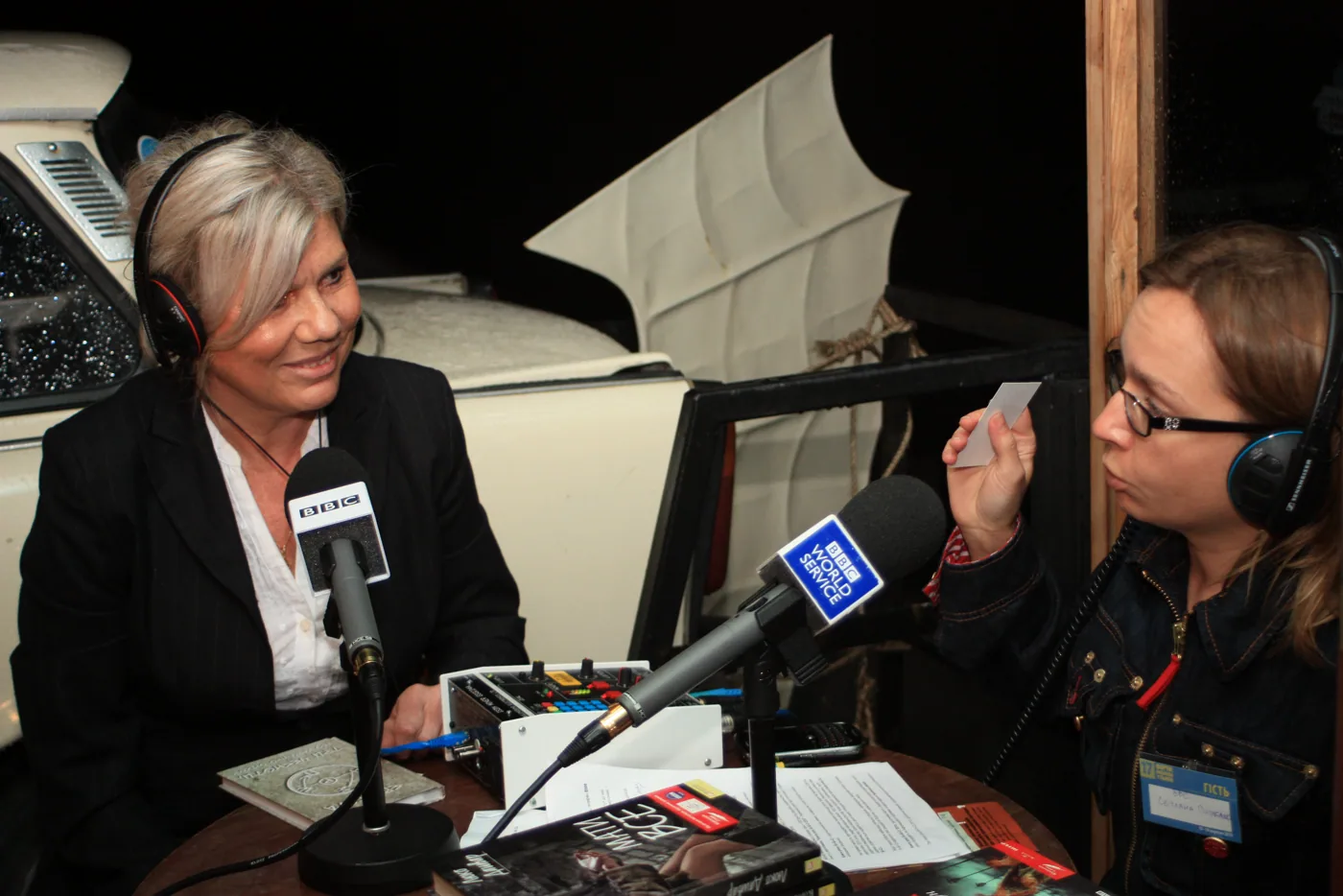
Writer Eva Gata (left) and Svitlana Pyrkalo: the nominee’s interview with the BBC. (Photo by Kostiantyn RODYK.)
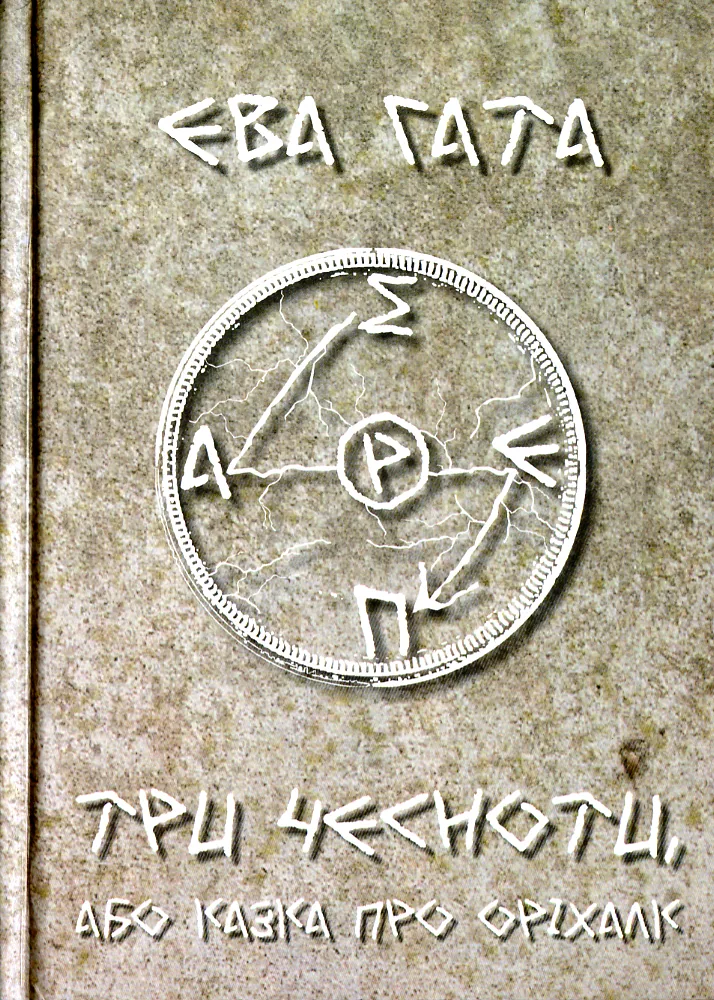
In 2010, the "philosophical-mystical novel" (as the press called it) "Three Virtues, or a Tale of Orichalcum" was shortlisted for the BBC Book of the Year award.
By that time, it was already the fifth book of the Lviv writer Eva Gata, while the first ("Purification, or I Do What I Want", 2007) had been reissued and translated into Russian and German (in Austria).
Its nationwide recognition came primarily from a genre unusual at the time: a remarkably bold combination of a practical, self-help component — let us call it “how to feel happy” — with plot-based reinterpretations of ancient myths.
It took the form of a parable, rooted on the one hand in the Biblical tradition and extending on the other into today’s myth-making literary mainstream. Even then, Paulo Coelho — the global benchmark — was mentioned with good reason alongside Eva Gata.
Indeed, Eva Gata may be regarded as the catalyst for two literary trends that are flourishing today. The self-help component blossomed into books “about the Ten Commandments of Success”: Ukrainian authors saw that they too could and should work in the territory of Carnegie and company.
Literary reinterpretations of mythology, meanwhile, are only now gaining popularity among writers and readers. Consider Volodymyr Yermolenko’s “Ocean Catcher”, published two years earlier, with its authorial retelling of Odysseus’s story.
Incidentally, Eva Gata’s penultimate book tells of Professor Maksymilian’s journeys, which seem to echo the voyage of Ulysses — even in the final existential summation: “Once more he returned to the world of ordinary people, which in his youth he had so dreamed of escaping.” Another contemporary “follower” of Eva Gata is Mykola Khomych.
Khomych’s novels “Space X, or the Territory of Lies” (2013) and “The Secret of the Tomb” (2016) draw on Varangian historiosophy; Eva Gata, however, had already published “From the Varangians to the Greeks, or a Story Traced in Runes” in 2008.
Older Ukrainians generally encountered ancient Greek mythology through the retellings of the Russian professor N. Kun. His “Legends and Myths of Ancient Greece” was republished countless times in the USSR (even in Soviet Ukraine there were five translations), but it offered a purely totalitarian version: an enthralling account of the gods’ wisdom and the heroes’ valour. Only now are we beginning to glimpse what Greek folklore truly is.
“Mythology is a catalogue of unspeakable cruelty,” Umberto Eco writes in the foreword to the multi-volume scholarly “History of European Civilisation”, which he edited (Kharkiv: Folio, 2015).
Eva Gata seems to take this definition by the Italian master as her point of departure. She searches for a way out of the labyrinth of incessant crime surrounding Olympus, convinced that a “light at the end of the tunnel” truly exists and is called Love — a radically different interpretation of ancient myth.
Eva Gata is the no-longer-secret pseudonym of Olha Kossak, a researcher at Lviv University, whose mathematical models were even used in the military industry.
She collaborated with two Greek universities, in Athens and Thessaloniki, while researching the mathematical foundations of computer graphics. Those extended research visits seem to have provided the impetus for her turn to ancient mythology. She also seems to have begun writing in response to an external prompt.
As Iryna Kliuchkovska writes in her memorial foreword to Eva Gata’s newly published posthumous book “Strange Stories” (Lviv: BaK, 2019), “her love of life was so all-embracing that, after speaking with her, the world mysteriously seemed better, brighter, and more colourful.”
I met Ms Olha when her first book was published, and even that first semi-formal encounter fully confirmed the description above. Later, at book fairs, I repeatedly saw listeners and spectators emerge from Eva Gata’s presentations as if enchanted and eagerly buy her new releases.
In the words of Iryna Kliuchkovska, this resulted from an “understanding that... through our thoughts and words we can draw goodness towards ourselves”. Or, as one character in “Three Virtues...” is described, “she attracts everything she thinks about”.
Olha was not only a pioneering researcher but also a persuasive teacher: she taught people how to learn. She was therefore a brilliant moderator of her own presentations. I am sure that those admirers and buyers also took pleasure in the books they bought.
However, it was not all so simple with literary appreciation. Olha Kossak, removing the Eva Gata mask, did not automatically become a writer.
Most of her admirers were searching for recipes for happiness, now wrapped in a broadly melodramatic plot. Even the triumphant “Three Virtues...” — triumphant, one might say, for a beginning writer — suffers from pseudo-aphorism mixed with generic fantasy and fairy-tale clichés.
But it contained two elements fundamental to her work. First, a declaration that runs through all her books, which cannot leave any reader indifferent who understands the merciless pressure of the everyday: "I do not want to be buried alive, I want to nurture a happy soul."
Second, the author formulated her concept of the archaeology of consciousness: "Once a philosopher said: 'I know that I know nothing.' And he was right.
But if he had said: 'I know that I know everything, I just need to remember,' — that would also have been true. Our soul knows everything, and if we start from this position, we can discover new secrets every day that were once already known."
Thus, the author prescribed self-analysis, attention to the signs around, and warned against taking them lightly.
Yes, at first everything was mixed with banalities, because this is the language and consciousness of the 'people,' and the author aimed to reach the mass reader. But soon she made a clear choice in favour of literature.
A revealing example is “Roots of Light” (Lviv: BaK, 2016), in which one character — apparently the author’s alter ego — is described in the emphatically past tense: “She created her own illusion of a theatre, in which she was forever the prima donna. Unlike the others, she became the happiest among the happy and the most glorious among the glorious, the only one in her own universe.”
Now the author chooses words much more carefully, reaching a true aphoristic quality, as in: «Which is better — when the truth reveals itself, or when it is unknown?». And in the same memorable manner, the main message of all of Eva Gata’s work is declared: «Metamorphosis or death. There is no other way».
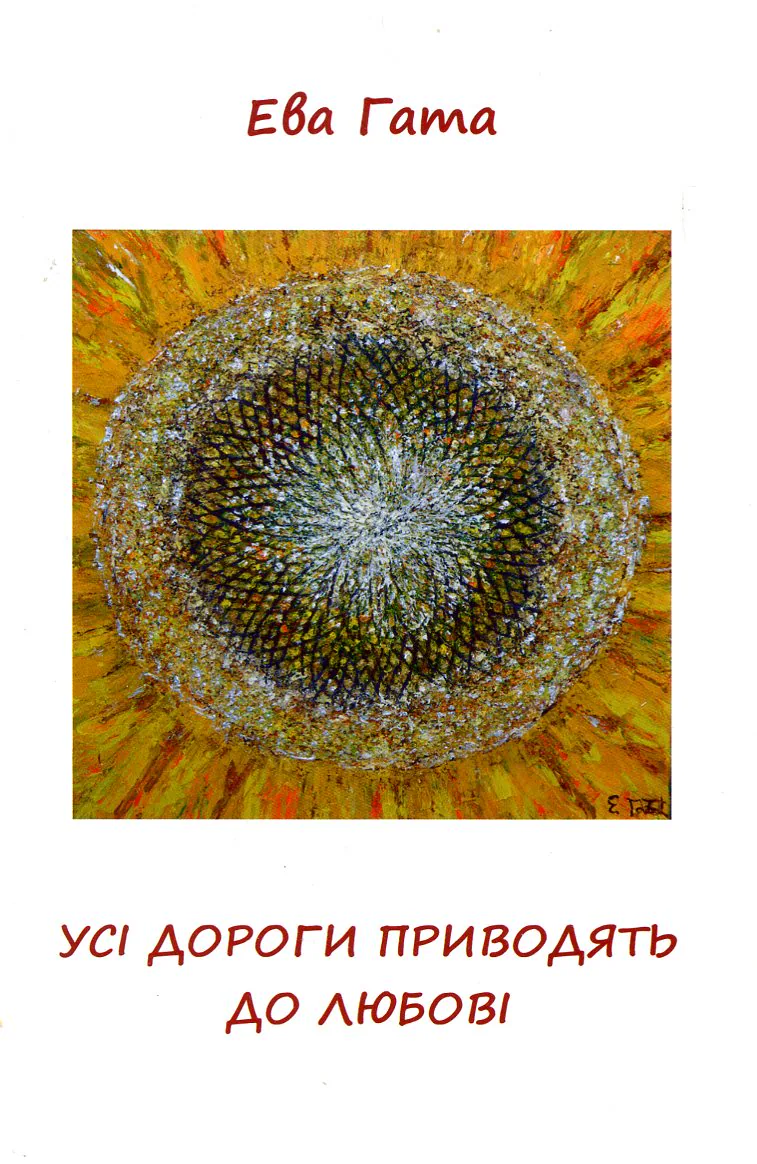
In my view, Eva Gata’s greatest literary achievement is the previous year’s book “All Roads Lead to Love” (Lviv: BaK, 2018). To understand its deepest meaning, one must know that it was written during the second year of Olha’s fierce struggle with perhaps the most aggressive form of cancer, one that statistically leaves patients almost no chance. Pain regularly attacked her — and still she wrote.
Naturally, illness — or, more precisely, the spiritual means of overcoming it — is the dominant theme. It runs through both the novella and the three cyclically linked short stories in the book. The novella, provocatively titled “Thought Creates the World Around Us — and Not Always the One We Dream Of”, is, in effect, a day-long conversation among three patients in an oncology clinic, women who “give every word, every phrase, a special sacred meaning”.
Conversations in a hospital ward are like 'The Canterbury Tales': 'Have you heard about Saint Expeditus, who helps in times of anxiety?.. He is considered the patron of difficult matters and urgent affairs, people turn to him with the most incredible problems, even actors.'
Or this: “The students asked their teacher what they should do to become happy. He answered, ‘When you eat, eat; when you walk, walk; when you work, work; when you sleep, sleep.’ The students replied that this was exactly what they did, but the teacher objected: ‘When you eat, you walk; when you walk, you work; when you work, you sleep.’ There is no need to seek happiness: it is always with us, and the search for it is a sign of emptiness... Do not neglect simple things; immerse yourself in happiness.”
In fact, all of this concerns the illness that brought the women together for a time, and each of the three has her own, now quite specific, interpretation of it. One says: “I heard that you can catch cancer by carelessly talking left and right about someone who is ill, because you become a conduit of information, or the link that closes a chain.”
The second says, “This illness arises from a feeling of fear.” The third treated her diagnosis “not as a sentence but as a final warning”: “And then the thrill of the game awoke within me.
The sorrow was swept away as if by the wind and, most importantly, the thirst for life returned. I had to become a warrior... Either you win this game, or there is nothing more for you to do here... Excitement replaced panic.”
Here one must mention the Dutch philosopher Johan Huizinga, who regarded “the concept of play as a distinct and highly important factor in everything that happens in the world... We could quite justifiably call play ‘totality’ in the modern sense of the word” (“Homo Ludens”. — Kyiv: Osnovy, 1994).
In Eva Gata’s “All Roads...”, we also find this term, and in a thoroughly Huizingian sense: “Live totally.” The writer ceased to be a piece in the game, as she had been in her early books, and became a player leaning over the chessboard. She gained the distance indispensable for turning utterance into prose.
And, as in chess theory, a multitude of gambits arise. “You are not ill; the time has come to free yourself,” we read in Eva Gata’s work. This unmistakably points us to Clarissa Pinkola Estés, the researcher of the “neglected areas of the female soul”, who is equally convinced that “whatever happens has the capacity for transformation” (“Women Who Run with the Wolves: Myths and Stories of the Wild Woman Archetype”. — Kyiv: Yakaboo Publishing, 2019).
“Open the secret chest, release Love from it, and fill your space with it,” writes Eva Gata. This too recalls Estés and, even more strongly, Coelho’s path: “When you are loved, you can achieve anything in the world... You do not even need to understand what is happening, because it all happens within you, and then a person can become the wind” (“The Alchemist”. — Lviv: Klasyka, 2000).
Eva Gata writes about the ‘discovery of a hitherto closed inner space,’ about how ‘it is frightening to observe an empty space,’ and about those who ‘have built a false space around themselves.’ And how can one not recall Yaroslav Melnyk, with his ‘Distant Space’: ‘The only purpose of treatment can be to return to a person their close space’ (Kyiv: A-BA-BA-HA-LA-MA-HA, 2019).
Once, cultural theorist Vadym Skuratovskyi wrote — ‘instead of a foreword and instead of a monograph’ — an introductory word to a book of short prose by Oksana Zabuzhko, where he noted ‘the palimpsest of this writing’ (Sestro, Sestro. — Kyiv: Fakt, 2003).
Eva Gata’s works are also palimpsests: texts from beneath which ancient, hard-to-identify writing emerges. By and large, the mythological Olympus is for her something like Vernadsky’s noosphere, where all wisdom expressed in words is stored and where alone one can discover the answers to the question “why?”
“When I wrote ‘The Tale of the Viburnum Pipe’, I did not know how I knew certain things,” Oksana Zabuzhko once said in an interview. That tale draws on the legend of the perelesnyk serpent from the noospheric storehouse — a legend Eva Gata also interprets in “All Roads...”. Their interpretations proved different.
“I have spent my whole life writing about a world in which love is growing cold,” Oksana Zabuzhko admits (“From the Map of Books and People”. — Chernivtsi: Meridian Czernowitz, 2012). “Open the secret chest, release Love from it, and fill your space with it,” says Eva Gata (“All Roads Lead to Love”).
“Whatever you believe in, that is what you will have... Think, learn, give thanks, and act” (Eva Gata).